Sabtu, 23 November 2013

Tugas B.inggris bisnis 1 : Tips & Trick About interview

TIPS & TRICK about Interview

Nama : DARARI ALBAJILLY
NPM : 29110373
Kelas : 4KB04

Startup Company Interview Preparation
This list of interview tips was written by Jeremy McCarthy, the CEO of VentureLoop, who has over 15 years of experience working and recruiting with the venture capital community and with startups. While nothing guarantees a successful interview, the information provided can help candidates better prepare themselves for success in the interview process with a startup company.
Purpose - get an offer
The purpose of any interview is to get an offer. Even if you have concerns about the company or job during your interview, make sure you still interview your best. You can always say no to an offer when it arrives. You can rarely overcome a poor first impression if you later decide your initial instincts about the position were mistaken.
Research
Go online and find out as much information as you can about the company and anyone you will be interviewing with. Companies are blown away when you can mention press releases, know their revenue numbers, quote statistics, know backgrounds of executives, etc. For startup companies, you should know who the venture capital investor is, know which partners sit on their board, and know how much money they have raised so far. Many times this information is not available, but some savvy online searching can turn up valuable information about a company.
Most companies like to hire people who are experts in their industry, and startups are no exception. They have to answer to their investors when things don't go well, and executives don't want to tell their venture capital investors that they had a poor product launch after hiring a product manager with no experience in their industry. Know the company, know their industry, know their competitors, and use their product if it is available.
Rehearse
Most successful athletes and performers visualize their craft prior to playing or performing. Try to visualize your interview and how you will present yourself and answer questions prior to interviewing. If you get nervous during interviews, you might even consider having someone you know do a mock interview before you go. The more you practice, the more comfortable you are, and the less nervous you will be when the interview arrives.
Cover strengths, weaknesses, etc.
Think about questions related to where you are in 2 to 5 years, your most difficult work situation, your most stressful job, your favorite job, what kind of person you'd like to work for, etc... Sit down and come up with answers to all of the stereotypical questions that get asked in interviews. You don't want to get caught making something up off the cuff, only to think later "DOH! I shouldn't have said that!" If they ask where you see yourself in the next X number of years, let them know that you are more focused on the current position at this time, but you would obviously want to be considered for appropriate promotions as you master this position and show high performance. And take a few minutes to write down the questions and answers so that you don't have to re-invent the wheel with each interview.
Prepare for Behavioral Questions
Many companies use an interview technique known as behavioral interviewing. This method of interviewing asks candidates to give specific examples of situations they have encountered. For example, "tell me about a time you didn't meet a deadline and how you handled it." Take time to go through the questions below and write out examples to keep for future interviews. It can be difficult to come up with good examples to behavioral interview questions on the spot, and you will be far better served if you can determine good examples in advance.
Work-related examples of:
·         How you handled not meeting a deadline
·         How you dealt with conflict with a co-worker or boss
·         What you did when someone else's actions caused your project to fail
·         When you have shown initiative
·         What you did when a customer was upset with you
·         A time when a co-worker blamed you for something that was not your fault
Appearance
Remember to ask ahead of time what the expectation is on your attire. It is always preferable to over-dress for an interview unless you know the company has a strict casual environment. Make sure you are well groomed. If you are a coffee drinker, smoker, or have lunch/breakfast prior to an interview, be aware of your breath. Use a mint or brush your teeth prior to your interview. Do NOT chew gum during an interview. Do not wear perfume/cologne or wear little enough that someone cannot smell it unless they are closer than one foot from you. Think about how you appear when you are confident and on top of the world. Head high, standing straight and tall, a slight smile, relaxed.
Arrival
Arrive for your interview at least 5 minutes early but no more than 10 minutes early. Everyone has their watch set differently, and giving a 5 minute cushion is a good idea. Some interviewers are also very time-sensitive and notice if you're even one minute late. However, arriving more than 10 minutes early will often pressure the first interviewer if they are not ready for you yet. Plan to arrive 15 to 20 minutes early in the parking lot and enter the building about 5 minutes early. If you are running late or think you might be late, call ahead of your arrival to let them know.
Introduction
When introducing yourself to each interviewer, give your first and last name, make eye contact, and let the interviewer be the person to initiate a handshake. When shaking hands, match the pressure of their handshake. Do not be limp or unusual with the way you shake hands. Wait a moment and smile at the interviewer after meeting them.
Presentation
Your body language tells a lot about you in an interview. Sit up straight. Lean slightly forward in your chair. Keep eye contact with your interviewer as much as possible (especially be aware of this when you are the one speaking as many people make eye contact when listening but not when speaking). Stay alert. When you go through a long interview process, you can sometimes start to show weariness, and startups often have a high energy culture. Make sure you project energy and do not appear tired. Try to mirror your interviewer's demeanor and style. Be yourself, but let them set the tone of the interview and match their energy level and body language. Never swear or use casual words like "yeah" and "uh-huh". Even if your interviewer swears and speaks casually.
Take Notes
Bring a notepad or portfolio and a pen to take notes during each interview. This is a very effective way to show your interest in the opportunity and your attention to detail.
Biggest challenges? Where can I contribute?
Ask each interviewer what the biggest challenges of the position are at the beginning of the interview. Write down what they tell you and focus on how you can overcome those challenges with your skills and background during each interview. This question basically gets the interviewer to tell you what their hot buttons are, and each person will have different hot buttons for the same position. Also, focus on how you can help them, not on what the company has to offer you. Where can you contribute to their company, team or project?
Forbidden topics - money, benefits, office tour, overtime
Never bring up money on your first interview. If they ask what you're making, be honest but tell them that you feel it's probably premature to talk money at this point and, besides, you're interested in evaluating the entire opportunity rather than the salary alone. Let them know that you're confident that you both can work out a fair offer if you are both interested in moving forward. Don't ask about benefits info or to take an office tour. Those things will come at a later time. And never ever ever bring up overtime. Even in a positive way. The interviewer will almost always remember that overtime was discussed during the interview, and they will perceive it negatively, regardless of how you positioned it. If you want to express that you work hard and long hours, let them know that you do whatever it takes to get the job done and that you are quite familiar with startup culture and expectations.
Want, not Need
Companies don't like to hire people who seem desperate. Interview with a confident style that shows you want the job, but don't give the impression that you need the job. Even if you desperately need the job. If you have been out of work for awhile and have been getting a lot rejections, inevitably an interviewer will ask you what your interviewing experience has been the past few months. Let them know you are having a very positive experience evaluating companies and opportunities. Tell them you are being selective in your interviewing process to find the right opportunity for yourself.
Laid off or Fired
It is always awkward to let an interviewer know why you left your last job if you were laid off or especially if you were terminated for cause. Never lie when asked. While it might be unfair, many hiring managers assume the poorest performers are cut when layoffs occur. Be prepared to answer your layoff question with information that will dispel any assumption someone might have about cutting the poor performers. Try to show that there was a specific business reason behind your layoff. Your department was eliminated. The office was moved. The product you supported was being discontinued, etc.
Being terminated for cause is always difficult to answer. Never use the word "fired" when describing your situation and instead use a softer term like "let go". Do not go into great detail about the circumstances and do not express anger, blame, or a grudge. Speak with confidence when discussing the situation and do not appear meek or apologetic. Look the person in the eye the entire time you are discussing what happened. If possible, offer a reference at the company who will give you a solid reference about performance. If you can't get a reference at the company that terminated you, find a reference at a previous company that will give a reference to help show you are a solid performer and offer up that information at the time of discussing your termination with the interviewer. If you show that you are uncomfortable and lack confidence when discussing this subject, you will give an interviewer the impression that there is little doubt the last company made the right decision.
Close - Any concerns about ability to do job? Next step? These are the two MOST important questions in each interview you have. You should ask them of each individual interviewer.
·         Do you have any concerns about my ability to do this job? - This is your last chance to make sure you didn't leave out anything in your background or incorrectly communicate anything during the interview. Once you leave the interview, it's almost impossible to change someone's incorrect impression. Be direct and try to get a sincere response from the individual.
·         I'm very excited about this opportunity. What's our next step? - This might very well be the deciding factor in getting an offer. Even if you have reservations, express to each interviewer that you are definitely interested in the position and want to know what you need to do next to keep the process moving. And make sure that you actually SAY it in words at the end of the interview. Don't assume that they should have noticed your enthusiasm and interest level from the rest of your comments during the interviewing process. Trust me. They didn't. On numerous occasions I have seen a less qualified candidate get the job over a more qualified candidate based almost entirely on their perceived interest level in the position.
Follow up
Always follow up with a company after you interview within 24 hours. In this electronic age, it is appropriate to send an email to each person who interviewed you if you have their email address. If you do not have everyone's email address, you can ask for their email addresses from someone whose email you do have. If you really want to impress someone, send a written thank you card. It is rare that people send written thank you cards today, and it will make you stand out as someone who took the extra time to do it. Thank the interviewer for his or her time, re-iterate your interest in the opportunity, and mention one area from your notes that answers the interviewers hot button area (you did ask them what the biggest challenges of this position are during the interview, right?).


Jumat, 08 November 2013

Tulisan 2 B.inggris Bisnis 1

10 Komputer Terunik Di Dunia

Beikut ini ulasan tentang !0 komputer terunik di dunia ;

1. Spoiler for Sony Vaio Zoom: 

Highlights: kaca faktor bentuk tipis, teknologi holografik touchscreen, layar benar-benar transparan dan keyboard berjalan buram ketika dimatikan.
2.Spoiler for B-membrane:

Highlights: built-in proyektor yang menghilangkan kebutuhan akan sebuah monitor yang terpisah, keyboard membran yang muncul bila diperlukan, optical drive terintegrasi, proyektor lampu balok dapat ambien.
3. Spoiler for Book Laptop:

Highlights: ini menampilkan tren yang kita telah menjadi begitu tergantung pada teknologi dan dunia maya, bahwa kita telah melupakan tentang hidup kita sendiri
4. Spoiler for The Napkin: 

Highlights: Menggunakan e-tinta dan teknologi RF, dirancang untuk kolaborasi kelompok, telah pena seperti modul yang mengirimkan info ke PC base station, info diproses ditampilkan pada serbet yang sebenarnya e-kertas tinta.
5. Spoiler for Canvas: 

Highlights: dirancang bagi mereka di bidang seni kreatif, menawarkan lebar untuk ruang kerja.
6. Spoiler for Dual Screen Computer: 

Highlights: slot besar di belakang layar LCD yang dapat menampung notebook sehingga memungkinkan Anda untuk menggunakannya sebagai desktop, notebook layar berubah menjadi layar kedua dalam modus potret.
melalui desain Yanko
7. Spoiler for Mac Folder: 

Highlights: re-bekerja User Interface yang mirip dengan iPod Touch atau iPhone ‘layar, super tipis multi-touch.
8. Spoiler for Evolve Modular: 

Highlights: mengubah antara konfigurasi komputasi mobile dan rumah dan dapat memperluas atau kontrak berdasarkan komponen modul untuk memenuhi kebutuhan setiap pengguna.
9. Spoiler for HP LIM: 

Highlights: penggunaan kain Bambu di bingkai aluminium PC, 19 “sentuh layar OLED transparan bersama dengan keyboard nirkabel, trackpad virtual.
10. Spoiler for MacBook Touch: 


Curiculum Vitae

New Penggilangan Street
Dukuh , 13550
(021) 87795174
darari_albajilly@ymail.com

November, 11, 2013

Mr . / Mrs . / Dr . Leadership
PT.Metrodata Electronics, Tbk 
Cibitung - Bekasi

Dear Mr / Mrs . Leadership ,
Based on the information I got from www.jobstreet.co.id that the company is Mr / Mrs lead today requires employees as a Hardware Engineer . Therefore I apply for the post .
I graduated S1 Computer Systems , unmarried , honest , disciplined , attractive , responsible, and able to work together in teams and individually.
As consideration for the Mr / Mrs helped me attach herewith :
Copy of diploma Last 1 Sheet
Photo 4 x 6 1 Sheet
Copy ID 1 Sheet
Curriculum Vitae 1 Sheet
Similarly petition I created this work in good faith , great hope I kindly Mr / Mrs can receive my work at a company that Mr / Mrs lead . For your attention Mr / Ms before and afterward I thank you .

Sincerely,


Darari Albajilly


Contact Information
  • Name                  : Darari Albajilly
  • Address              : New Penggilingan street, rt 10/04 kel.Dukuh kec.Kramat jati Jakarta timur.
  • Telephone          : 021-877795174
  • Cell Phone          : 085693521952
  • Email                    :darari_albajilly@ymail.com

Personal Information
  • Date of Birth      : 25 October 1991
  • Place of Birth    : Jakarta
  • Citizenship        : Jakarta
  • Visa Status        : Indonesia
  • Gender              : Male

Optional Personal Information
  • Marital Status       : Single
  • Spouse's Name  :     -
  • Children                :     -

Employment History
  • Working at Cv.Indra Wisnu Pratama, Bogor.
  •  Period : June 2010 - March 2011
  • ·Position: Mechanical Production

Education
  • 2014 Graduate In Gunadarma University (Computer System), Depok.
  • 2010 Graduate In Islamic Senior High School PB.Soedirman, Jakarta.
  • 2007 Graduate In Junior High School 20, Jakarta.
  • 2004 Graduate In Elementary School 05 Dukuh Village, Jakarta.

Professional Qualifications
  • Certifications and Accreditations
  • Other Skills
Technical Skills
  • Computer skills (MS Word, Excel, Power Point)
  • Fluent in English both oral & written
  • Able to work in a team with strong, interpersonal and communication skill
  • Good Knownledge of Hardware Monitoring and trobleshoot server
Curriculum Vitae so I created this with the actual


Darari Albajilly

Senin, 07 Oktober 2013

Tulisan 1 Bahasa Inggris Bisnis 1

Nama : Darari Albajilly
Kelas  : 4KB04
Npm   : 29110373


FAKTA MENARIK MENGENAI BAHASA INGGRIS

01. menurut undang2x negara bagian illinois, berbicara bahasa inggris adalah ilegal, bahasa resmi yang dikenal adalah "bahasa amerika"

02. hanya ada satu kata dalam bahasa inggris yang memiliki huruf dobel 3 set berturut-turut yaitu : "BOOKKEEPER"

03. hanya ada satu kata dalam bahasa inggris yang hanya memiliki 1 buah vokal yang muncul sebanyak 5 kali : "INVISIBILITY"

04. terdapat kata dalam bahasa inggris yang terdiri dari 7 huruf yang memiliki 10 kata didalamnya tanpa harus merubah susunan huruf2xnya : "THEREIN": the,there,he,in,rein,her,here,ere,therein,herein.

05. terdapat dua kata dalam bahasa inggris yang memiliki keseluruhan 5 huruf vokal secara berurutan (a-e-i-o-u) :"ABSTEMIOUS" dan "FACETIOUS"

06. Kira2x terdapat 6500 bahasa yang digunakan di dunia saat ini.namun sekitar 2000 dari bahasa ini digunakan oleh kurang dari 1000 orang. Bahasa yang digunakan paling luas didunia adalah bahasa mandarin.terdapat 885juta orang yang menggunakan bahasa itu di cina

07. hanya terdapat dua urutan huruf yang terdiri dari 4 huruf berurutan secara alphabetical yang dapat ditemukan pada bahasa inggris: "RSTU" dan "MNOP" contohnya : "UNDERSTUDY" dan "GYMNOPHOBIA".

08. hanya terdapat empat kata dalam bahasa inggrisyang berakhiran "DOUS" : TREMENDOUS,HORRENDOUS,STUPENDOUS, DAN HAZARDOUS.

09. paling sedikitnya terdapat 2 kata dalam bahasa inggris yang menggunakan seluruh huruf vokal, secara berurutan, dan diakhiti dengan huruf "Y" : "ABSTEMIOUSLY" DAN "FACETIOUSLY"

10. kata "QUEUE" adalah satu satunya kata dalam bahasa inggris yang pengucapannya masih sama walaupun 4 huruf terakhirnya dihilangkan.

11. kata "HONCHO" berasal dari bahasa jepang memiliki arti "kepala regu"(squad leader) dan pertama kali digunakan dalam bahasa inggris selama pendudukan amerika di jepang pada perang dunia II.

12. kata terpendek dalam bahasa inggris dengan keseluruhan hurufnya dalam urutan alphabetical adalah : "ALMOST"

13. negara philipiha memiliki lebih dari 1000 dialek daerah dan memiliki 2 bahasa resmi.

14. satu2xnya team MLB Amerika (major League Baseball) yang memiliki nama kota dan nama klubnya bukan dalam bahasa inggris adalah SAN DIEGO PADRES

15. kata terpanjang dalam bahasa finlandia adalah "epaejaerjestelmaellistyttaemaettoemyydellaens aeka eaen" yang dalam bahasa inggris berarti "'even with their lack of ability to disorganize'

16. kata terpanjang dalam bahasa inggris menurut Oxford English Dictionary adalah :neumonoultramicroscopicsilicovolcanokoniosis kata lainnya yang memiliki jumlah huruf yang sama adalah pneumonoultramicroscopicsilicovolcanoconioses yang berarti jamak/plural

17. kata dengan satu suku kata terpanjang dalam bahasa inggris adalah "screeched".

18. huruf yang paling banyak digunakan dalam bahasa inggris adalah "E" dan huruf
yang paling sedikit digunakan dalam bahasa inggris adalah "Q"

19. bahasa cina tidak membutuhkan tanda baca.

20. afrika selatan sebelumnya memiliki 2 bahasa resmi, namun sekarang memiliki 11 bahasa resmi.

21. Seoul,ibukota korea selatan, memiliki arti "ibukota" dalam bahasa korea.

22. dari keseluruhan kata dalam bahasa inggris dengan delapan huruf, hanya satu
kata yang hanya memiliki 1 huruf vokal didalamnya : "STRENGTH"

23. hanya 3 kata dalam bahasa inggris yang diakhiri dengan "CEED" : "PROCEED",EXCEED" DAN "SUCCEED"

24. dari keseluruhan kata dalam bahasa inggris, kata "SET" memiliki paling banyak definisi.

25. dari keseluruhan bahasa di dunia, bahasa inggris memiliki kosa kata terbanyak didunia sekitar 800.000 kata.

26. tidak ada bahasa yang memiliki sinonim (persamaan kata) lebih banyak dari bahasa inggris.

27. di vulcan, alberta canada, papan ucapan selamat datang bagi turis ditulis dalam 2 bahasa yaitu inggris dan klingon (bahasa alien dari film "star trek")

28. bahasa perancis adalah bahasa resmi di inggris selama lebih dari 600 tahun.

29. Don Quixote, karangan Miguel de Cervantes Saavedra telah diterjemahkan ke lebih banyak bahasa dari seluruh buku lain diluar kitab injil.

30. menurut Guinness Book of World Records kata bahasa finlandia SAIPPUAKIVIKAUPPIAS adalah kata palindrome (memiliki kesamaan bunyi di awal dan akhir kata) terpanjang yang diketahui

31. "UNDERGROUND" adalah satu satunya kata dalam bahsa inggris yang dimulai dan diakhiri oleh huruf "UND"

32. "The sixth sick sheik's sixth sheep's sick" disebut sebagai toughest tongue twister (kalimat paling sulit diucapkan) dalam bahasa inggris. coba aja kalo gak percaya

33. "four" adalah satu2x nya angka dimana jumlah hurufnya sama dengan angkanya.

34. "FORTY" adalah satu2x angka yang memiliki huruf dalam urutan
alphabetical. "ONE" adalah satu2nya angka dimana huruf2xnya tersusun terbalik dalam urutan alphabetical

35. "RHYTHMS" adalah kata bahasa inggris terpanjang tanpa vokal normal a-e-i-o atau u

36. lebih dari 1000 bahasa berbeda yang digunakan di benua afrika.

37. huruf yang paling umu dalam bahasa inggris adalah : R S T L N E

38. "GO" adalah kalimat lengkap terpendek dalam bahasa inggris

39. Somalia adalah satu2xnya negara di benua afrika dimana seluruh populasinya berbicara bahasa yang sama yaitu bahasa somalia.

40. Bahasa yang paling sulit dipelajari adalah BASQUE yang digunakan di wilayah utara spanyol dan wilayah selatan perancis. 

sumber : http://indonesiaindonesia.com/f/48077-fakta-menarik-mengenai-bahasa-inggris/

Rabu, 02 Oktober 2013

TUGAS SOFTSKILL B.INGGRIS BISNIS 1

Nama : Darari albajilly
NPM : 29110373
Kelas : 4KB04

Parts of a Business Letter

A business letter is a formal letter with six parts:

The Heading
The heading contains the return address with the date on the last line. Sometimes it is necessary to include a line before the date with a phone number, fax number, or e-mail address. Often there is a line skipped between the address and the date. It is not necessary to type a return address if you are using stationery with the return address already imprinted, but you should always use a date.  Make sure the heading is on the left margin.
Example:
Ms. Jane Doe
543 Washington St
Marquette, MI 49855
Tel:
Fax:
Email:
June 28, 2011 

Recipient’s Address
This is the address you are sending your letter to. Be sure to make it as complete as possible so it gets to its destination. Always include title names (such as Dr.) if you know them. This is, like the other address, on the left margin. If a standard 8 ½” x 11” paper is folded in thirds to fit in a standard 9” business envelope, the inside address should appear through the window in the envelope (if there is one). Be sure to skip a line after the heading and before the recipient’s address, then skip another line after the inside address before the greeting. For an example, see the end of this sheet for a sample letter. 


The Salutation
The salutation (or greeting) in a business letter is always formal. It often begins with “Dear {Person’s name}.” Once again, be sure to include the person’s title if you know it (such as Ms., Mrs., Mr., or Dr).  If you’re unsure about the person’s title then just use their first name. For example, you would use only the person’s first name if the person you are writing to is “Jordan” and you’re not sure if he or she is male or female.
The salutation always ends with a colon.

The Body
The body is the meat of your letter. For block and modified block letter formats, single space and left justify each paragraph. Be sure to leave a blank line between each paragraph, however, no matter the format. Be sure to also skip a line between the salutation and the body, as well as the body and the close.
                  
The Complimentary Close
The complimentary close is a short and polite remark that ends your letter. The close begins at the same justification as your date and one line after the last body paragraph. Capitalize the first word of your closing (Thank you) and leave four lines for a signature between the close and the sender’s name. A comma should follow the closing.

The Signature Line

Skip at least four lines after the close for your signature, and then type out the name to be signed. This often includes a middle initial, although it is not required. Women may put their title before had to show how they wish to be addressed (Ms., Mrs., Miss).
The signature should be in blue or black ink.

Enclosures

If you have any enclosed documents, such as a resume, you can indicate this by typing “Enclosures” one line below the listing. You also may include the name of each document.


Format and Font

Many organizations have their own style for writing a business letter, but here  are some common examples.

Block

The most common layout for a business letter is called a block format. In this format, the entire letter is justified to the left and single spaced except for a double space between paragraphs.


Modified Block
Modified block is another popular type of business letter. The body of the letter and the sender’s and recipient’s addresses are left justified and single spaced. However, in this format, the date and closing are tabbed to the center point.

Semi-Block

The least used style is called a semi-block. In it each paragraph is indented instead of left justified.

Font

The standard font for business letters is Times New Roman, size 12. However, fonts that are clear to read such as Arial may be used.

Sample Letter
{NOTE: your name goes only at the bottom}
Your Return Address (no abbreviations for Street, Avenue, etc.)
Your City, YO [your two letter state abbreviation] zip
Date (write out either like June 4, 2004 or 4 June 2004)
First and Last Name of the Person to whom you are writing 
Address 
City, ST zip
Dear Mr./Ms. Whomever:
In the first paragraph, introduce what you are writing about and what you want from them.
In the subsequent paragraphs, explain the nature of your problem and what they can do for you. Be non-combative and straight to the point.
In the last paragraph, be sure to thank him/her for his/her time and efforts on your behalf. Also, let them know that you will contact them or that they can contact you with any questions.
Sincerely yours,
{four spaces so that your signature may appear here}
Jane Doe
A business letter is not restricted to one page; the letter should be as long as it needs to be.

Types of Business Letters 
Letter writing is a prized skill in the world of work. The higher you advance in your career, the more you will need to write letters. Letters are more formal and official than other types of business communication. They offer personal, verifiable authorization. Unlike e-mail, letters often must be routed through channels before they are sent out. Letters are the expected medium through which important documents such as contracts and proposals are sent to readers.


There are four basic types of business letters: inquiry letters, special request letters, sales letters, and customer relations letters. Business letters can be further classified as positive, neutral, or negative. Inquiry and special request letters are neutral, sales letters are positive, and customer relations letters can be positive or negative.


Inquiry Letters
An inquiry letter asks for information about a product, service, or procedure. Businesses frequently exchange inquiry letters, and customers frequently send them to businesses. Three basic rules for an effective inquiry letter are to state exactly what information you want, indicate clearly why you must have this information, and specify exactly when you must have it.


Special Request Letters
Special request letters make a special demand, not a routine inquiry. The way you present your request is crucial, since your reader is not obliged to give you anything. When asking for information in a special request letter, state who you are, why you are writing, precisely what information you need, and exactly when you need the information (allow sufficient time). If you are asking for information to include in a report or other document, offer to forward a copy of the finished document as a courtesy. State that you will keep the information confidential, if that is appropriate. Finally, thank the recipient for helping you.


Sales Letters
A sales letter is written to persuade the reader to buy a product, try a service, support a cause, or participate in an activity. No matter what profession you are in, writing sales letters is a valuable skill. To write an effective sales letter, follow these guidelines: (1) Identify and limit your audience. (2) Use reader psychology. Appeal to readers' emotions, pocketbook, comfort, and so on by focusing on the right issues. (3) Don't boast or be a bore. Don't gush about your company or make elaborate explanations about a product. (4) Use words that appeal to readers' senses. (5) Be ethical.


The "four A's" of sales letters are attentionappealapplication, and action. First, get the reader's attention. Next, highlight your product's appeal. Then, show the reader the product's application. Finally, end with a specific request for action.


In the first part of your sales letter, get the reader's attention by asking a question, using a "how to" statement, complimenting the reader, offering a free gift, introducing a comparison, or announcing a change. In the second part, highlight your product's allure by appealing to the reader's intellect, emotions, or both. Don't lose the momentum you have gained with your introduction by boring the reader with petty details, flat descriptions, elaborate inventories, or trivial boasts. In the third part of your sales letter, supply evidence of the value of what you are selling. Focus on the prospective customer, not on your company. Mention the cost of your product or service, if necessary, by relating it to the benefits to the customer. In the final section, tell readers exactly what you want them to do, and by what time. "Respond and be rewarded" is the basic message of the last section of a sales letter.


Customer Relations Letters
These deal with establishing and maintaining good working relationships. They deliver good news or bad news, acceptances or refusals. If you are writing an acceptance letter, use the direct approach-tell readers the good news up front. If you are writing a refusal letter, do not open the letter with your bad news; be indirect.


Follow-up Letters. A follow-up letter is sent to thank a customer for buying a product or service and to encourage the customer to buy more in the future. As such it is a combination thank-you note and sales letter. Begin with a brief expression of gratitude. Next, discuss the benefits already known to the customer, and stress the company's dedication to its customers. Then extend this discussion into a new or continuing sales area, and end with a specific request for future business.


Complaint Letters. These require delicacy. The right tone will increase your chances of getting what you want. Adopt the "you" attitude. Begin with a detailed description of the product or service you are complaining about. Include the model and serial numbers, size, quantity , and color. Next, state exactly what is wrong with the product or service. Briefly describe the inconvenience you have experienced. Indicate precisely what you want done (you want your money back, you want a new model, you want an apology, and so on). Finally, ask for prompt handling of your claim.


Adjustment Letters. Adjustment letters respond to complaint letters. For an adjustment letter that tells the customer "Yes," start with your good news. Admit immediately that the complaint was justified. State precisely what you are going to do to correct the problem. Offer an explanation for the inconvenience the customer suffered. End on a friendly, positive note. For adjustment letters that deny a claim, avoid blaming or scolding the customer. Thank the customer for writing. Stress that you understand the complaint. Provide a factual explanation to show customers they're being treated fairly. Give your decision without hedging or apologizing. (Indecision will infuriate customers who believe they have presented a convincing case.) Leave the door open for better and continued business in the future.


Refusal of Credit Letters. Begin on a positive note. Express gratitude for the applicant for wanting to do business with you. Cite appropriate reasons for refusing to grant the customer credit: lack of business experience or prior credit, current unfavorable or unstable financial conditions, and so on. End on a positive note. Encourage the reader to reapply later when his or her circumstances have changed. 


Style Of Business Letter

Business letter can be written with different styles, such as:
Full Block.
Full block style is a letter format in which all text is justified to the left margin. In block letter style, standard punctuation is placed after salutations and in other headings. Open punctuation, however, refers to a modification of style where all nonessential punctuation is omitted. A few key factors will help you understand block style format and the difference that open punctuation makes.
Description: http://hadi27.files.wordpress.com/2012/11/block-letter-parts.gif?w=230&h=300
  1. Return Address:  If your stationery has a letterhead, skip this. Otherwise, type your name, address and optionally, phone number. These days, it’s common to also include an email address. 2. Date: Type the date of your letter two to six lines below the letterhead. Three are standard. If there is no letterhead, type it where shown.
 3. Reference Line: If the recipient specifically requests information, such as a job reference or invoice number, type it on one or two lines, immediately below the Date.
 4. Special Mailing Notations: Type in all uppercase characters, if appropriate.
5. On-Arrival Notations: Type in all uppercase characters, if appropriate. You might want to include a notation on private correspondence.
 6. Inside Address:  Type the name and address of the person and/or company to whom you’re sending the letter, three to eight lines below the last component you typed. Four lines are standard.
 7. Attention Line: Type the name of the person to whom you’re sending the letter.
 8. Salutation: Type the recipient’s name here. Type Mr. or Ms. [Last Name] to show respect, but don’t guess spelling or gender.
 9. Subject Line: Type the gist of your letter in all uppercase characters, either flush left or centered. Be concise on one line.
 10. Body: Type two spaces between sentences. Keep it brief and to the point.
11. Complimentary Close: What you type here depends on the tone and degree of formality.
12. Signature Block: Leave four blank lines after the Complimentary Close to sign your name. Sign your name exactly as you type it below your signature. Title is optional depending on relevancy and degree of formality.
 13. Identification Initials: If someone typed the letter for you, he or she would typically include three of your initials in all uppercase characters, then two of his or hers in all lowercase characters.
14.  Enclosure Notation: This line tells the reader to look in the envelope for more. Type the singular for only one enclosure, plural for more.
15. cc: Stands for courtesy copies (formerly carbon copies). List the names of people to whom you distribute copies, in alphabetical order.
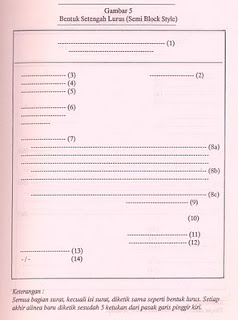
Semi-block style
Semi-blok fromat: in a format this text parallel left and all paragraphs in the letter is indented. Format shape on this letter on letter head, date, complementary a close, and signature being in a position flattened right. In the layout uneven right, but can dibilangg flattened middle. Other parts on a letter as inside address, subject, salutation, body of letter, and enclosure if terdapatnya attachment letter,Being flattened on the left.
Sample Form Letter Semi Block Style :
Description: http://hadi27.files.wordpress.com/2012/11/semi-block-style.jpg?w=222&h=300
Description:
1.Kop Letter
2. Date of preparation of letters
3. Letter No.
4. attachment
5. case
6. The letter addressed
7. a word of salutation
8a. Introduction letter
8b. Explanation letter
8c. The cover letter
9. Greetings Closing
10. Name of office
11. signature
12. Names to approach
13. copy
14. Attachment page letter / initials
Description: http://hadi27.files.wordpress.com/2012/11/4.jpg?w=225&h=300
Simplified-style
Simplified-style business letters contain all the same elements as the full-block and semi-block letters. Like the full-block format, the simplified format left-justifies every line except for the company logo or letterhead. The date line is either slightly right of center or flush with the center of the page. Letters written in the simplified format have fewer internal sections, such as the body, salutation and date line.
Using the simplified style is the most useful at times when you don’t have a recipient’s contact name. Because the simplified style does not require a salutation, you don’t need the person’s name. The simplified format does away with unneeded formality while maintaining a professional approach.
Description: http://hadi27.files.wordpress.com/2012/11/a9.jpg?w=250&h=300
Hanging-Indented Style
This very useful style places the first words of each paragraph prominently on the page. It is useful for letters that deal with a variety of different topics. However, for normal business communications, this style is very rarely used. The first line of the paragraph begins at the left-hand margin. And the other lines of the same paragraph are indented three to four spaces. This is the reversal of semi-indented style discussed in other page.
Description: http://hadi27.files.wordpress.com/2012/11/8.jpg?w=291&h=300


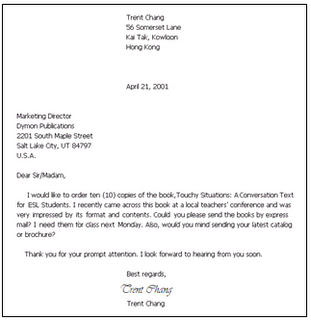
Example of Bussiness Later

3519 Front Street
Mount Celebres, CA 65286

October 5, 2013

Ms. Betty Johnson
Accounts Payable
The Cooking Store
765 Berliner Plaza
Industrial Point, CA 68534

Dear Ms. Johnson:
It has come to my attention that your company, The Cooking Store has been late with paying their invoices for the past three months.
In order to encourage our customers to pay for their invoices before the due date, we have implemented a discount model where we'll give you 2% off your invoice if you pay us within 10 days of receiving the invoice.
I hope that everything is going well for you and your company. You are one of our biggest customers, and we appreciate your business. If you have any questions, feel free to contact me at (555) 555-5555.

Sincerely, 

Signature
Darari Albajilly